The capture of Nathan Gombet and rescue of Carson Drew
The Hidden StaircaseThe capture of Nathan Gombet and rescue of Carson Drew resolve two linked dangers: Gombet’s campaign of intimidation and Carson’s secret imprisonment. Nancy Drew’s discovery of her father in Gombet’s house turns the sheriff’s earlier demand for proof into an immediate confrontation, ending with Gombet handcuffed and Carson freed from the chair to which he had been bound.
Background and the Need for Proof
The conflict had begun with a land dispute. Some time earlier, land belonging to Nathan Gombet had been condemned for a railroad right of way. Carson Drew, who served on the land commission, believed Gombet had been well paid and had initially appeared satisfied with the settlement. After a bridge was built, however, Gombet pressed the commission for additional money, arguing that the bridge had damaged the property he retained. Carson regarded those claims as unreasonable, a disagreement that helps explain the grievance Gombet later invoked.
When confronted at the Drew home, Gombet described the settlement as cheating and demanded either the deed back or a higher price for his land. Carson connected that grievance to Gombet’s earlier attempt to rummage through his desk for the deed, but told him that possessing it would not help him. The dispute over compensation supplied Gombet with a stated complaint; it did not justify the coercive methods he subsequently used to pursue money.
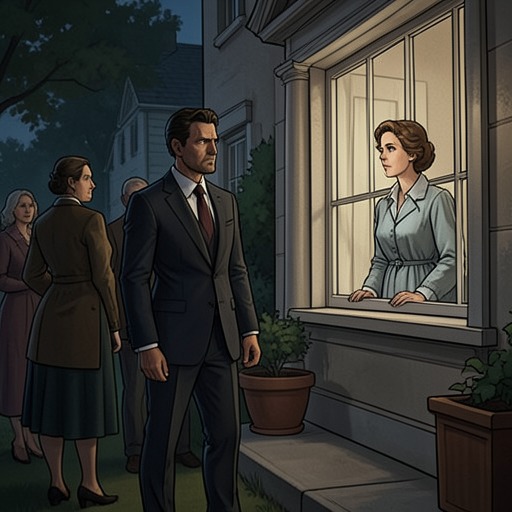
Before the arrest, Nancy Drew had reported the strange events at the Turnbull house and her discoveries there to the sheriff. Rosemary Turnbull and Floretta Turnbull corroborated her account, and Nancy identified Gombet as responsible and asked for his arrest. The sheriff said he believed the account but would not proceed without evidence of guilt. Nancy offered to show him the staircase, while the sheriff named the recovery of the silver urn or comparable evidence as the kind of proof he needed. That hesitation establishes the procedural turn in the eventual capture: the accusation alone had not been enough, but finding Gombet with Carson and the coercive agreement made the danger and the alleged crime direct and immediate.
The Discovery in Gombet’s House
The arrest unfolds when Nancy hears Nathan Gombet speaking in a room where Carson is being held. She does not hear the full threat, because Gombet lowers his voice, but realizes that her father may be a prisoner and points the sheriff toward the chamber. The sheriff moves quietly with his pistol ready. Nancy, understanding that Carson is in danger, reaches the door ahead of him and throws it open without stopping to protect herself.
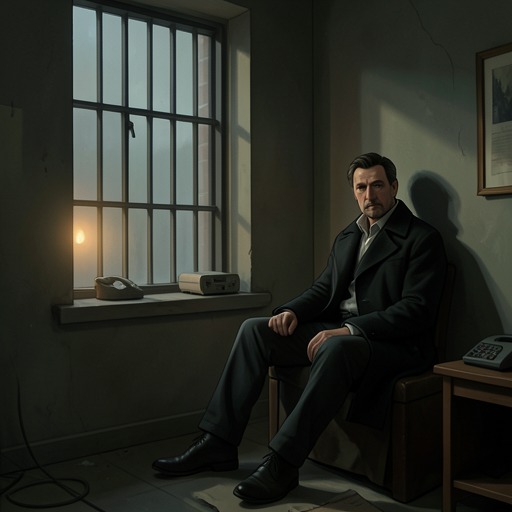
Inside, Carson is pale and haggard, bound to a chair, while Gombet leans over him. Gombet has a paper he is trying to make Carson sign and threatens that Carson will not get out unless he does. The scene supplies what the earlier report could not: Nancy and the sheriff encounter the alleged captor in the room with the captive, at the moment Gombet is pressing his demand. As Nancy warns that the police will act, the sheriff and his men close in around him and announce that his attempt is over.
Arrest and Rescue
Gombet tries to spring for the door, but a deputy catches him by the arm and pulls him back. The sheriff orders that he be handcuffed. Once Gombet understands that escape is cut off, he offers little resistance as the restraints are put on. The attempted flight and the sheriff’s command complete the arrest; the sequence shifts quickly from the danger inside the room to the officers’ control of the man who had created it.
Nancy immediately turns from Gombet to Carson and works at the ropes binding him to the chair. With a deputy’s knife, she cuts them and frees him. Carson tries to stand, but is too weak to remain on his feet and sinks back into the chair. Nancy helps him, asks whether he is hurt, and gives him a glass of water, which he empties at once. His release is therefore not an instant return to strength: he is free of the bindings, but exhausted and in need of support.
The Captivity Revealed
After Carson has been freed, he explains that Gombet induced him to come to the house by trickery and had kept him there for several days while trying to force him to sign over money. The episode thus reveals the connection between Gombet’s land grievance and his treatment of Carson: rather than pursue his claim through the commission, he sought a large payment through confinement and pressure. Carson identifies the paper on the table as the agreement Gombet wanted him to sign.
The document’s terms make the objective more specific. Carson says Gombet wanted him to hand over a large sum and then promise not to prosecute. The sheriff tells Gombet that there is no use denying his guilt because he was caught in the act, and says he will be taken to the station. Gombet responds sullenly and does not answer Carson’s direct question about seeking money that did not belong to him. The capture therefore closes the immediate crisis while clarifying the stakes: Carson is rescued, the attempted payment-and-silence agreement is exposed, and Gombet is in police custody rather than free to continue his pressure.